I’m a month late. Which might imply an in-depth look into the next game, but nope!
I could barely play this game before tapping out. [The previous game](last post) left me feeling nostalgic despite the flaws. Not Dark Cloud.
This game is a slog right from the beginning, and like many games in the AAA space, there’s a smaller game loop inside the main one. Also as usual, that inner game never gets a chance to flourish, and so becomes merely an optional reward system.
Let me step back a bit if you haven’t played this game before.
I.
Dark Cloud came out in the early 2000s. Not immediately after the release of the PlayStation 2 although still part of the early catalogue.
The narrative is prototypical RPG storytelling from that era: a random, inexperienced youth is called on to save the world from a great evil with a generic backdrop of motivation (i.e. nobody else is gonna do it). In this case, the youth is a village boy named Toan, and the great evil is a giant genie that eats everything.
As the genie goes around eating the world, the wise sage archetype of the story magics away all the people and things in the world into little orbs called Atlamilla.
The silent protagonist, Toan, takes in the major event and every other mundane observation in the dialogue by making this face:
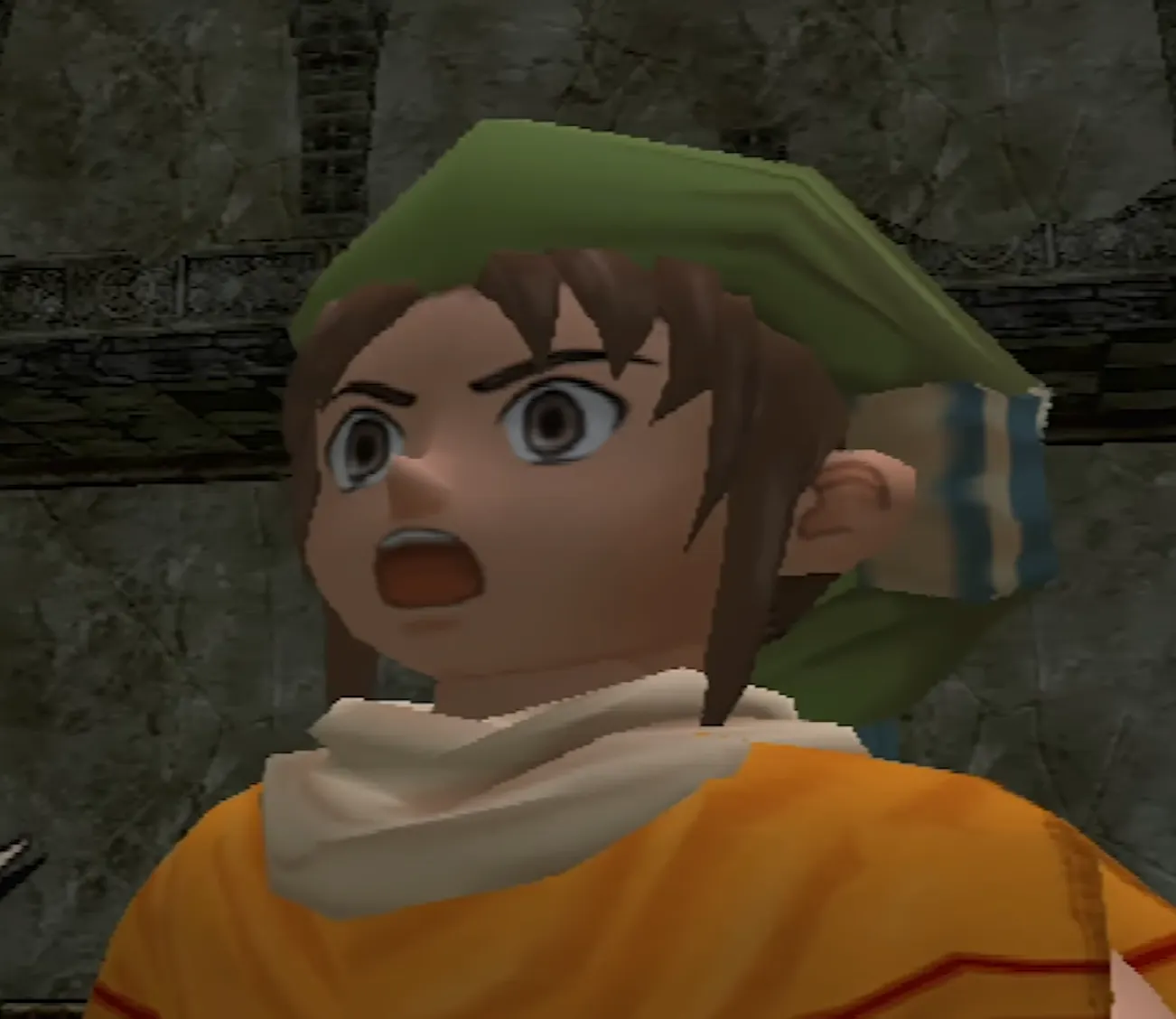
Anyway, in true modern fantasy style where the extremely powerful and supposedly good guys can’t be bothered to do anything except arrange the world for a nobody to play hero, Toan has to go around finding all the Atlamilla and put everything back in its place.
To be clear your mission is to restore the world, but the actual game is to do a bunch of tedious dungeons, fight a boss at the end of each one, and confront the big bad genie after all that. You only need to fetch Atlamilla and restore the various areas ‘enough’ to progress that main part.
II.
The unfortunate design in Dark Cloud is that the cookie cutter action mechanics are the main show.
I get it… it’s one of the simplest ways to get players interested. It looks good in trailers, it more or less maps to direct actions to what the player is pressing on a controller, and it mirrors our own movement in space.1
You also have to do bits of managing your health, a thirst meter (which slowly drains health when empty), and paying attention to your weapon durability. The weapons and their upgrades are your RPG stats equivalent, especially as you start collecting them like Pokémon to swap around while going through dungeons. If you lose durability on the weapon, it loses all of its upgrades.
The worst part of the dungeons by far is that you have to fight enemies until you get whatever the random ‘key’ is for unlocking the next floor. That’s it. Other than some items and alternate characters you unlock later on, you walk around on flat ground with the camera constantly giving you whiplash, waiting for that key to drop to move on.
Which brings me to the Atlamilla again.
A lot of designs experiment with games within the game. I think it’s unavoidable in the design space of video games due to the nature of how systems2 operate. They naturally contain substructures that can run and loop around independently, with interactions outside that loop merely orchestrating their start and end.
In Dark Cloud, the micro-game you’re playing is rebuilding each town/region after you open up the Atlamilla found in that area’s dungeon.
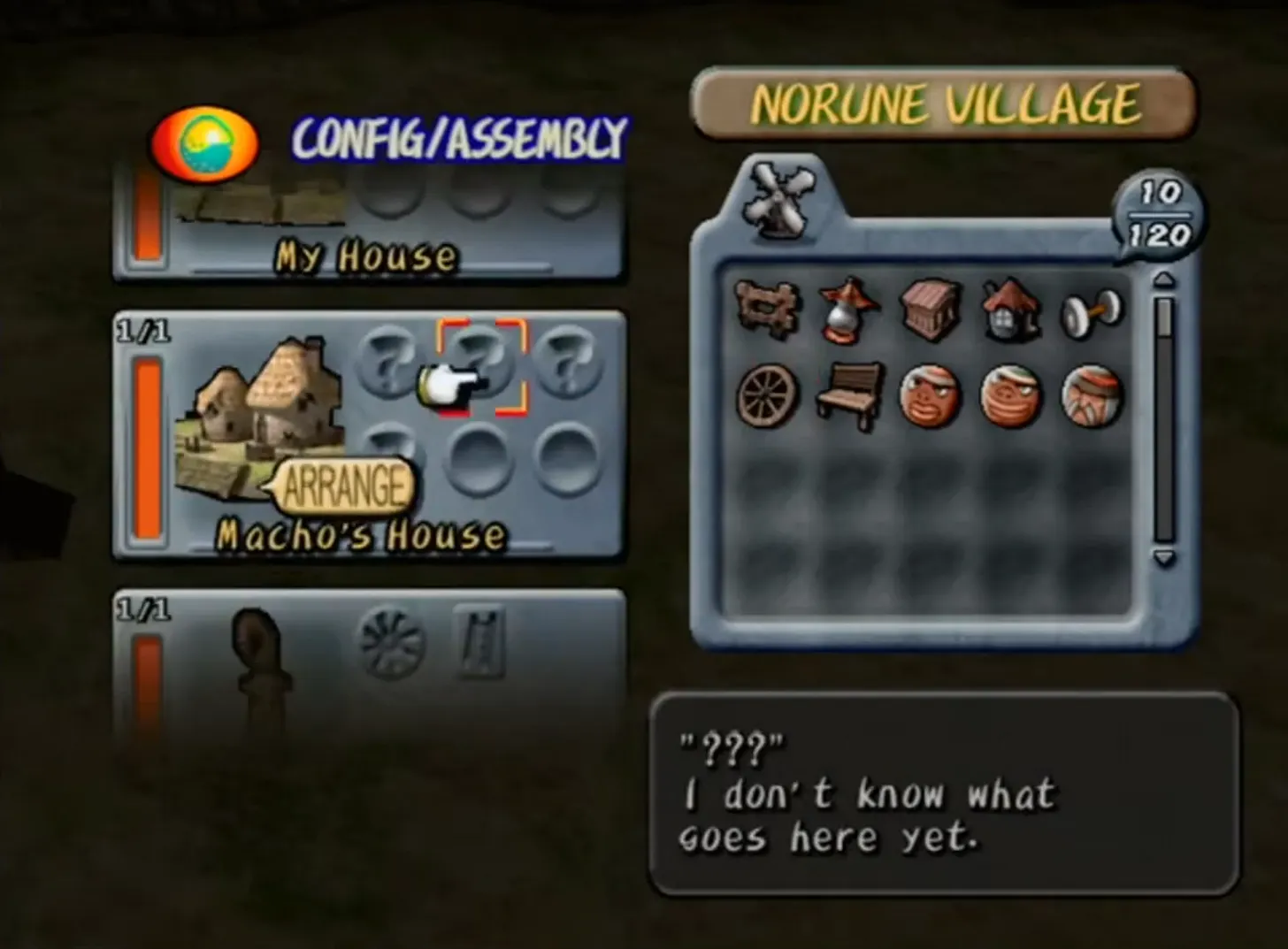
On its own, it’s a simple mechanic. There’s a list view that outlines a few types of objects you find: structures, people, and decor (I’m inventing these terms here to distinguish them, but the UI uses visuals to help you identify which is which).
Structures group the people and the decor, and when you place people in their respective structure, you can then go speak to them in the game world. Eventually as you work your way through the region’s dungeon, you rebuild the whole area back to its original state before the genie debacle at the beginning of the story.
III.
I said finding the Atlamilla and restoring the region is the micro-game, but the micro-micro-game is that, as you place things and speak with the characters, you can ask them for commentary about how to rebuild the town. The dialogue offered is usually a sentence or two, and it’s left to the player to understand exactly what arrangement would satisfy the request.
An example with one of the Macho Brothers (two of the little circles in the screenshot above) has you asking “How should I rebuild Norune?”, where the elder Macho brother responds with:
I’d like the house to be someplace where I don’t have to go far for a good workout.
It’s here where I think Dark Cloud does something tragic that many games do: it treats the far more interesting exercise of rebuilding the town as an optional activity with minor rewards rather than realizing it as a core game mechanic, leaning in, and pivoting to make that the main game.
This is the old-school AAA space I’m complaining about here, so this is pretty par for the course, but it’s sad to see these design problems so far back before the indie explosion around 2008 finally pressured bigger games to seriously experiment with mechanics again.3
Rebuilding the town is effectively a constraint-based puzzle. Except the first region is the only one that gives you something that might be considered a real prize for solving it. Every other region gives a character-specific weapon that can eventually get upgraded into their inconsequential ‘ultimate’ form.
The only game I can recall from recent memory that has a similar mechanic where you specifically are arranging things to try and satisfy these types of character-centric constraints is a small game called Littlewood. Recent meaning… 5 years ago.
I realize that many games have similar elements of this baked in, so I want to clarify what makes this feel unique in games like Dark Cloud or Littlewood: it’s that individuals make these requests of you that are hyper-specific to them. Sim games do this in aggregate, but this qualitatively changes the feel to be less of a puzzle and more of a spreadsheet exercise.
And don’t get me wrong, I love the sim genre too and how it’s evolved over the years. But it is worth emphasizing how the presentation and even small differences in mechanics can drastically change the way you perceive what you’re doing as you play the game.
Conclusion
Like I said, I quit during the first region after jogging my memory of this game. It’s a forgettable example of a common trope in game design of it’s era: very little risk-taking in the design resulting in a bland action combat game, hiding a potentially more interesting, but otherwise unsatisfying smaller game.
I have no problem admitting that I will still love a game when it has great style and not a lot of substance, but Dark Cloud is just one of those games during the rise of 3D on consoles though that doesn’t hold up very well in style or substance on replay.